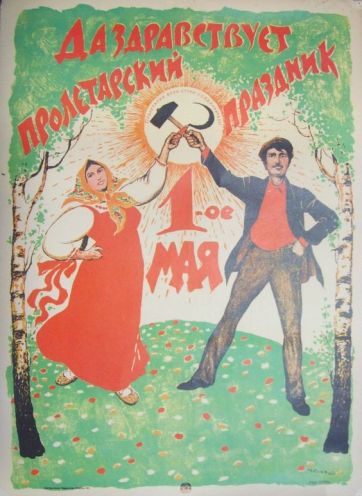
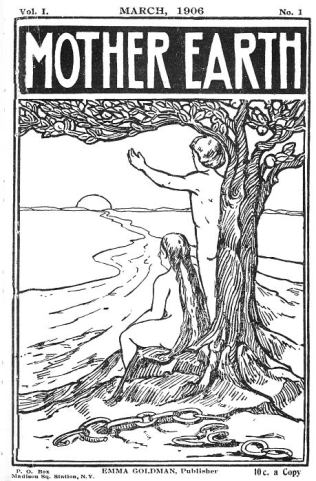
 Created by Ivan Simakov (1877-1925), the Soviet poster from May Day 1921 is like a synthesis of Crane’s picture and the cover to Mother Earth.* The colours in Simakov’s image are bright and clear and dominated by red and green. The world tree has been cleaved into two; the one and only magnificent tree, an ash-tree perhaps, has been substituted by two common birches. Between these birches stand a male and a female peasant. In front of the sun they raise the hammer and the sickle. The sun is not rising; it is already high in the sky. The tree supports stabilize and signify order, but it is the sun – and industrial and agrarian labour – that is the guarantee for prosperity and happiness. The place for the incarnation of the non-place (u-topia) is apparently on Soviet soil.
* Reproducerade in David King (2009). Red star over Russia: a visual history of the Soviet Union from 1917 to the death of Stalin, p. 129.
 Despite the fact that Walter Crane now and then played with baccantic motives and portrayed ludic games out in the wild, the more carnal aspects of the
  Heart in a Heartless World