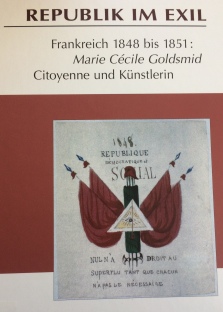
 Thanks to Dr. Bruno Leipold it is now possible to put yet another piece to the “Masonic G and Anarchist A” puzzle. While reading Raymond Rütten’s Republik im Exil. Frankreich 1848 bis 1851: Marie Cécile Goldsmid, Citoyenne und Künstlerin (2012) Dr. Leipold noticed, he kindly informed me, that the symbolism of the Fraternal Democrats seems to draw on the symbolism of a French group called “Association pour la propaganda démocratique et social”. A group I never encountered before.
 Dr. Leipold concluded his mail to me pointing out that: “Since, Harney and the Fraternal Democrats were quite close to their French counterparts, it seems like the symbol might have been a frequent component of social-republican/socialist iconography at the time.“ I can not but agree.
According to the caption in Rütten, the emblem with the A-like tool – i.e. the tool that I have some difficulties finding the proper English name for (“plumb bob”, “plumb square”, or just “plumb”?) – was originally, fittingly, in red. Hence, my clumpsy attempt to dye the emblem. (Looks somewhat street cool though…)
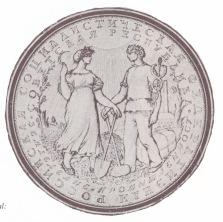 I would like to draw attention to a detail on a medallion deigned by Sergey Chekhonin (Tchehonine), from 1918.* On Chekhonin’s work of art an able-bodied female and a ditto male are depicted. The female stands before a cropland. She is carrying a sickle and a spade and so represents farmers. The male stands before a factory. He is holding a sledgehammer in his right hand, thereby seems to represent (despite Chekhonin’s choice of a non-factory tool as symbol) industrial workers. Behind him, on the ground, rests a parcel, perhaps with goods from his workplace. In his left hand – and it is this detail I found surprising – he carries a
 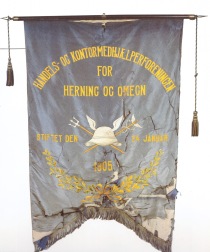 From the late 19th and early 20th century, we spot the caduceus – or Mercury himself, or symbols associated with him (especially his winged helmet) – on trade union banners and emblems. In Sweden and Denmark – and certainly in the countries that harboured workers’ movements that influenced the culture of these small countries, Germany and Britain above all – the banners and emblems decorated with this symbolism belong to unions that organized personnel working in shops, offices and akin workplaces.** This is hardly surprising since Mercury (Hermes) famously is, among other things, the god of commerce.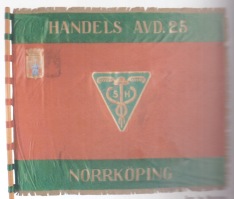
 By spring 1936, the French literati George Bataille famously came to the conclusion that Fascism had to be fought with its own means. For a surrealist inclined intellectual, this meant not jibbing at the darker sides of human existence: desire, perversion, violence, torture, sacrifice, fanaticism and death. For this aspiration, Bataille has been, quite erroneously according to my view, branded “Left fascist” by Richard Wolin.*
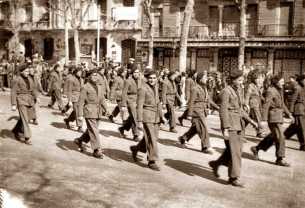 I wonder whether there are connections between this aspiration of Bataille and his friends and fascist-like feature in anarchism? I’m especially thinking about the obscure anarchist
 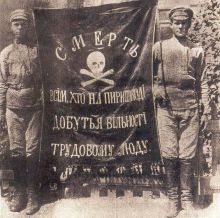 Already in the Russian Civil War,
  * I find the Wikipedia article on
  Remembering how left-wing friends in the 1980s took great interest in the Sandinista revolution in Nicaragua (recall The Clash’s album Sandinista! I personally backed the Contras, perhaps not my finest political decision), it is intriguing to learn from Donald C. Hodges’ Sandino’s Communism: Spiritual Politics For The Twenty-First Century (1992) how deeply involved
  Sandino seems to have taken a particularly keen interest in the religio-philosophical ideas of Escuela Magnético-Espiritual de la Comuna Universal, founded by Joaquín Trincado Mateo. The Magnetical-Spiritual School of Universal Commune, “the direct continuation” of the magical system “Moses founded 36 centuries ago”, if we are to believe
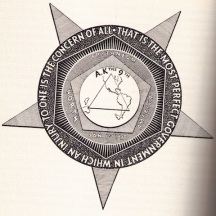 I’m reading the final draft for


 The red star of communism is one of the most familiar signs in modern politics. Still, there seems to be surprisingly little known about its origin. Like everything else that we encounter repeatedly, and has been present already from our childhood, the red star of communism appears palpable. But on reflection, this choice of symbol is of course far from evident: why on earth do a star painted red symbolise the movement that aim to abolish class societies?! During the last year, I have taken every opportunity to ask historians, even specialists in the history of socialism, if they knew the answer to this enigma, but they have left me empty-handed.
 In 1908, Alexander Bogdanov published
  (Nota bene, that the red star on this newyear postcard is, for some reason, a pentagon.)

 From the frontcover to The Democratic Review of British and Foreign Politics, History and Literature (1850). Harney, G. Julian (ed.). Vol. II. London: J. Watson.
 The Holy and Nobel Order of the
  Heart in a Heartless World
