My second example is the cover of the very first issue from 1906 of renowned anarchist Emma Goldman’s journal Mother Earth. At a verdant tree stands a young man and woman, maybe Ask and Embla. At the roots of the tree lays the fetters that they have just liberated themselves from. The man salutes the rising sun. They are both naked and the era seems to be simultaneously before the birth of civilisation and after its termination.
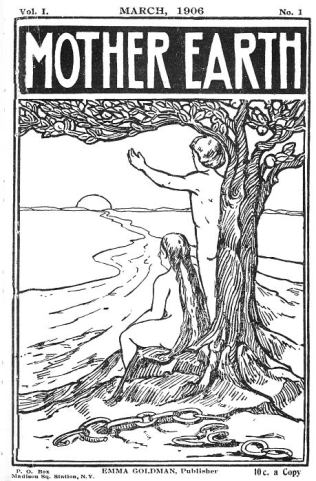 Despite the fact that Walter Crane now and then played with baccantic motives and portrayed ludic games out in the wild, the more carnal aspects of the thiasos were alien to the nature of his art. Likewise, the humans on this cover (by an unknown artist) lack any sense of sinfulness. Yet, the cover image, with the erected tree between the seperated lands, easily opens up for interpretations of a sexual sort. In any case, some kind of emancipated, physical senusalism is cherished. Reinforcing these arcadian qualities is the fact that whilst Crane maintained a hierarchical order, with the tree in the middle of the image, the visual “movement” on the cover is rather horizental: the glance of the viewers drift away from tree and mankind. The tree trunk may be pleasant to lean against, but it is the distant rising sun – and the utopian land its brings with it – that is the true centre of the world.
 I’m uncertain whether the interest in
 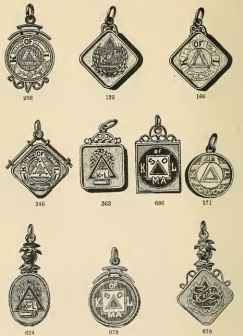 This blog post is decorated with medallions/charms from the Knights of Labor as displayed in F. Irons & Charles A. Russell, Illustrated Catalogue of Solid Gold. Society Emblems, Pins, Buttons and Charms, Providence, Irons & Russell (1895) and a marvellous pin from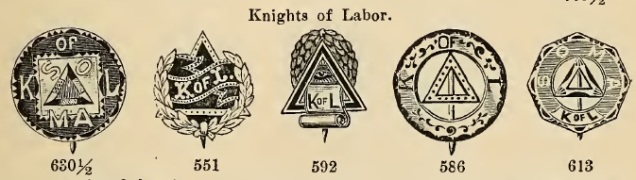
 I was surprised to find the topic “Soviet Swastika” being discussed on different pages on the Internet.
  The explanation is not shared fondness for totalitarianism, but the fact that the insignia was designed for Kalmyks fighting in the Red army. The Kalmyks are Buddhists and the swastika a well-known emblem for that creed. Thus, the explanation is some kind of Bolshevik tolerance, rather than totalitarianism.
 Female socialists take part in fighting for the cause, but their bodies is moreover regularly used as propagandistic icons. In contrast to the iconic liberal painting La Liberté guidant le peuple by Eugène Delacroix, the female socialists not only instigate and lead but take active part in the violent struggle. The essential message of these photos is thus the emancipation of women from enclosed homes, restrictive garments and patriarchal codes of conduct by martial empowerment.
 * Photos of
  The Holy and Nobel Order of the
  Heart in a Heartless World